Explore the system flow
A conceptual diagram based on the project documentation. Open each stage to read its context.
Product names and lexicon
TokoGenZ uses product names to help buyers find similar items and sellers understand the catalog. A dashboard adds price, sales, and rating context.
TF-IDF then clusters and neighbors
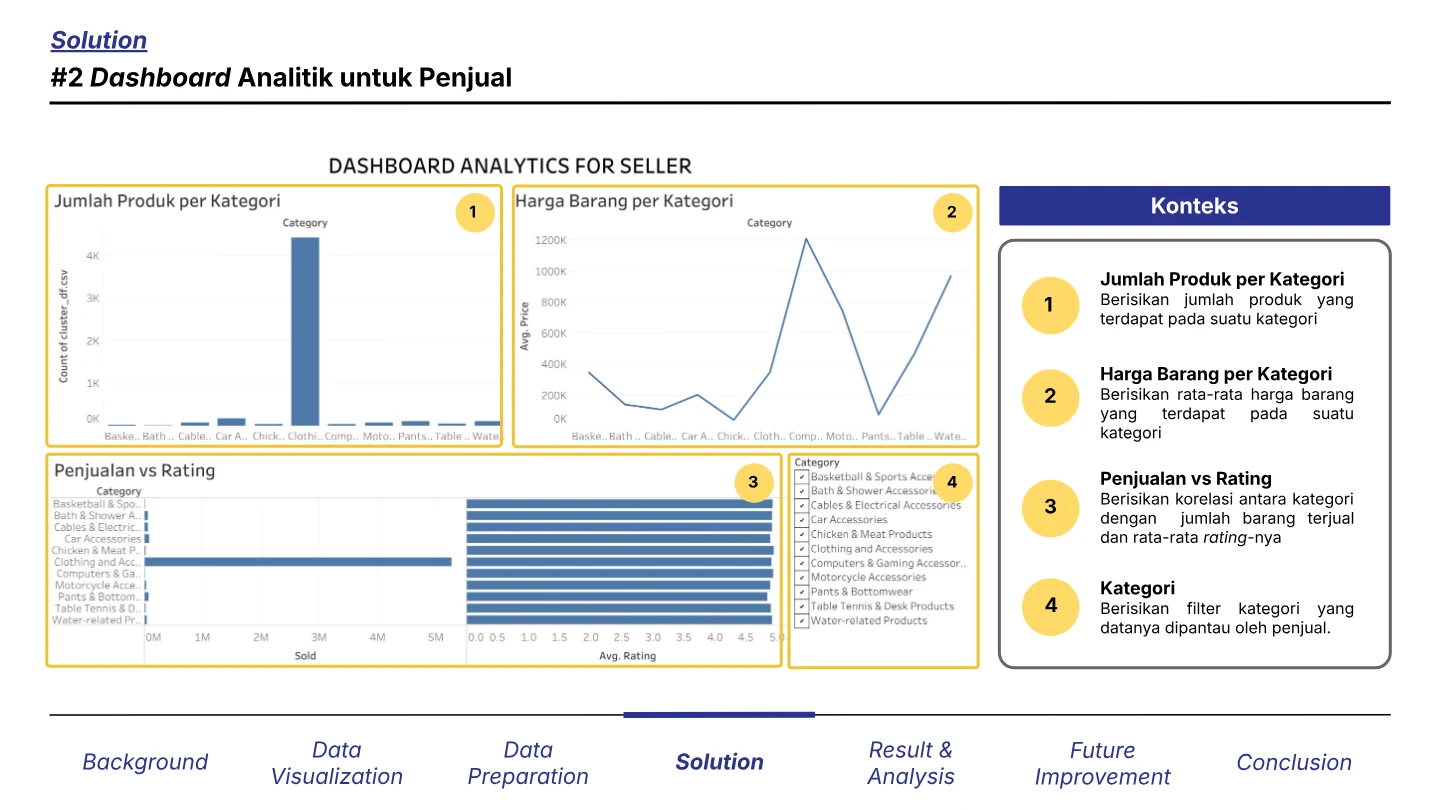
Product names are processed with a lexicon and represented as TF-IDF vectors. K-Means groups catalog items, and NearestNeighbors retrieves products with similar names. A Tableau dashboard lets sellers explore prices, sales, and ratings.
Recommendations and dashboard
Name similarity depends on spelling, synonyms, and catalog terminology. Further evaluation could use human relevance judgments and inspect products assigned to unsuitable clusters.
Problem and purpose
TokoGenZ uses product names to help buyers find similar items and sellers understand the catalog. A dashboard adds price, sales, and rating context.
Technical decisions
TF-IDF represents product-name terms, K-Means creates 11 clusters, and NearestNeighbors retrieves nearby items. Recommendations can be inspected through product-text similarity.
Role & contribution
Worked with the SySendiri team on product data using a lexicon and TF-IDF, K-Means clustering, and NearestNeighbors recommendations based on product-name similarity.
Technical workflow
Product names are processed with a lexicon and represented as TF-IDF vectors. K-Means groups catalog items, and NearestNeighbors retrieves products with similar names. A Tableau dashboard lets sellers explore prices, sales, and ratings.
Results & context
1st place at Hology 7.0 Data Mining. The model groups products into 11 clusters and recommends items by content similarity.
Evaluation limits and lessons
Name similarity depends on spelling, synonyms, and catalog terminology. Further evaluation could use human relevance judgments and inspect products assigned to unsuitable clusters.