Explore the system flow
A conceptual diagram based on the project documentation. Open each stage to read its context.
Uploaded photo
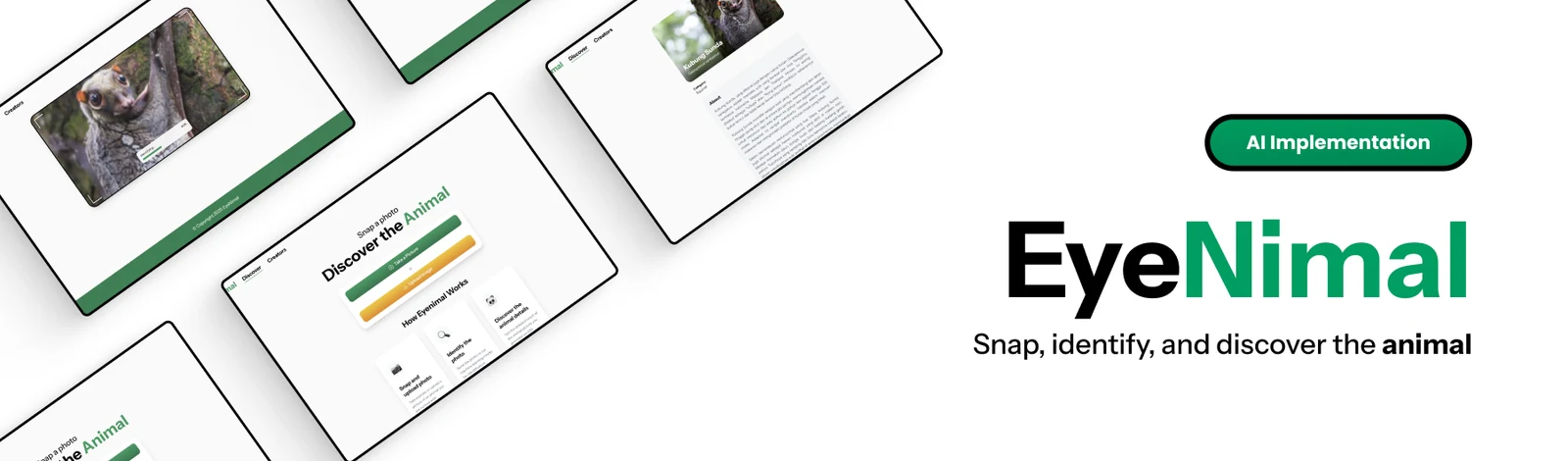
EyeNimal helps users explore possible animal classes from a photo. The interface needs to present the prediction alongside alternatives so users can inspect ambiguous shapes or backgrounds.
FastAPI and YOLO
The Next.js interface sends the uploaded photo to FastAPI for YOLO classification. Showing five candidates lets users see alternatives when class scores are close. The EfficientNet-B3 experiment used Animals10 and was evaluated separately from the app’s inference workflow.
Class and top five candidates
The 98.38% EfficientNet-B3 validation accuracy comes from the Animals10 experiment. The app uses YOLO. The report uses different labels for the train/test split and validation results, so the metric needs to be read alongside the paper’s methodology.
Problem and purpose
EyeNimal helps users explore possible animal classes from a photo. The interface needs to present the prediction alongside alternatives so users can inspect ambiguous shapes or backgrounds.
Technical decisions
The top five candidates make classification outputs easier to inspect. Separating Next.js and FastAPI creates a clear boundary between photo upload interactions and Python model inference.
Role & contribution
Collaborated in a three-member team on an animal-classification app. The system connects a photo-upload interface, training notebooks, and a Python inference service.
Technical workflow
The Next.js interface sends the uploaded photo to FastAPI for YOLO classification. Showing five candidates lets users see alternatives when class scores are close. The EfficientNet-B3 experiment used Animals10 and was evaluated separately from the app’s inference workflow.
Results & context
EfficientNet-B3 reached 98.38% validation accuracy in the Animals10 experiment. The app uses a YOLO model to show the class, confidence, and top five predictions.
Evaluation limits and lessons
The 98.38% EfficientNet-B3 validation accuracy comes from the Animals10 experiment. The app uses YOLO. The report uses different labels for the train/test split and validation results, so the metric needs to be read alongside the paper’s methodology.